

Lesson 15 Methodology: Weis Wave with Speed Index and Anchored VWAP in One Entry


Most entry methods give you one reason to take a trade. Lesson 15 asks for three. The volume has to show that the big players are there, the Anchored VWAP has to show where they got in and whether that price is holding, and a Plutus signal has to confirm the move before you commit. When all three line up, you are trading with the money that moves the market, not guessing against it.
All of it comes from just two tools. Here is the methodology step by step, for both shorts and longs, with real charts from our live results.
The two tools behind Lesson 15
Weis Wave with Speed Index: shows the total volume of each up and down wave, so an unusually large wave after a quiet period jumps out at you. It also gives the Plutus signals (PS = Plutus Short, PL = Plutus Long) that confirm strength or weakness and give you the actual entry.
Anchored VWAP: anchored at the start of that big wave, it tracks the average price those traders are holding. Once price crosses it, they are underwater.
Lesson 15 Short: step by step
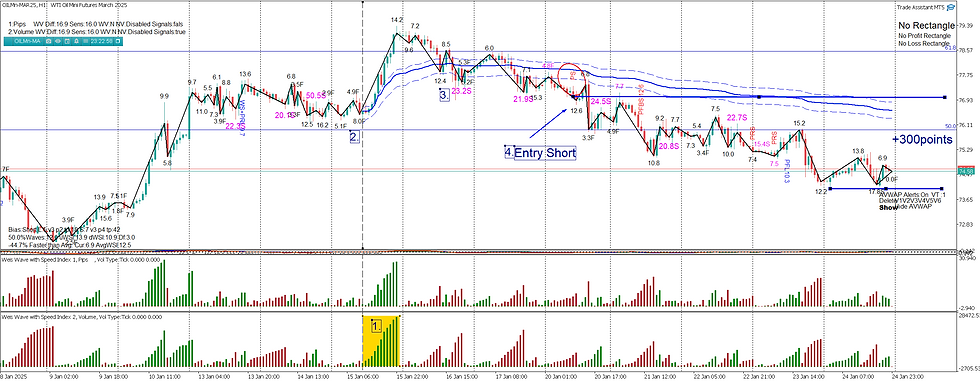
Fib 61.8%. Price reaches a 61.8% retracement, a level where sellers often come in.
Highest up volume wave in a while. A large up wave on that level suggests sellers are absorbing the buying inside it.
Anchor the AVWAP at the beginning of that up volume wave. Wait for price to cross below it and then pull back.
Highest down volume wave in a long time. Sellers reveal themselves.
Price respects the AVWAP as resistance on the pullback. The buyers from the up wave are now trapped.
Enter short on one more confirmation of weakness: a Plutus Short (PS) signal.

Lesson 15 Long: the mirror image
Large down volume wave breaking support. It could be a fake break. Buyers sometimes hide inside large down waves, so we wait for proof.
Anchor the AVWAP at the beginning of that down wave.
Wait for price to break the AVWAP upwards. The sellers from the down wave are now underwater.
Wait for the pullback and a Plutus Long (PL) signal to enter.

Why it works
A big volume wave tells you who stepped in. The Anchored VWAP tells you at what price. When price crosses that VWAP and then fails to get back above (or below) it, the traders from that wave are holding losing positions, and their exits fuel the next move. The Plutus signal keeps you from jumping in too early, so you enter after the market has shown its hand.
More Lesson 15 trades

Watch the full lesson
The complete walkthrough of the methodology, with examples, is on our YouTube channel.
Get the tools
You can trade Lesson 15 on both TradingView and MetaTrader 5.
On TradingView
Weis Wave with Speed Index (Plutus signals included) is available on TradingView by subscription on our site, with three plans to choose from. See what's included in the TradingView system.
Anchored VWAP is a free built-in drawing tool on the TradingView platform, so you can anchor it to your volume waves at no extra cost.
On MetaTrader 5
Both Weis Wave with Speed Index and our Anchored VWAP indicator (six independent anchors, drag-to-update and cross alerts) are available on MQL5.
Spotted a possible Lesson 15 on your chart? Post it in the Trade The Volume Waves Discord or send it by email and we'll go through it together.
Risk warning: Trade The Volume Waves offers general trading education that does not take into account your experience, objectives, financial situation or risk tolerance. Trading forex, crypto and CFDs carries a high level of risk. The results shown are past trades and are no indication of future results.
Comments